The BPE Tokenizer
Project source:
phase1_foundation/project2_tokenizer/Papers: “Byte-Pair Encoding: Subword-Based Machine Translation” (Sennrich, Haddow & Birch, 2016) · “A New Algorithm for Data Compression” (Gage, 1994 — original BPE) · WikiText (Merity et al., 2016)
Why subwords?
Chapter 1’s model saw characters: no unknown tokens, but every word cost many positions of context. Word-level models waste the opposite way: huge vocabularies and no way to handle unseen words. Byte-Pair Encoding sits in between, and it is the tokenization used by GPT-2, GPT-3, and most modern LLMs.
| Approach | Example | Pros | Cons |
|---|---|---|---|
| Character | "hello" → h e l l o | No unknowns, tiny vocab | Very long sequences |
| Word | "hello" → hello | Short sequences | Huge vocab, unknowns |
| BPE | "hello" → hello, "hells" → hell · s | Balanced, handles OOV | Moderate vocab |
Key properties:
- Handles OOV:
"unfriendliness"→un · friend · li · ness - Efficient: frequent words become single tokens
- Compositional: subwords recur across related words (
help,help · ing,help · ful) - No unknowns: worst case, every text degrades to characters
The training algorithm
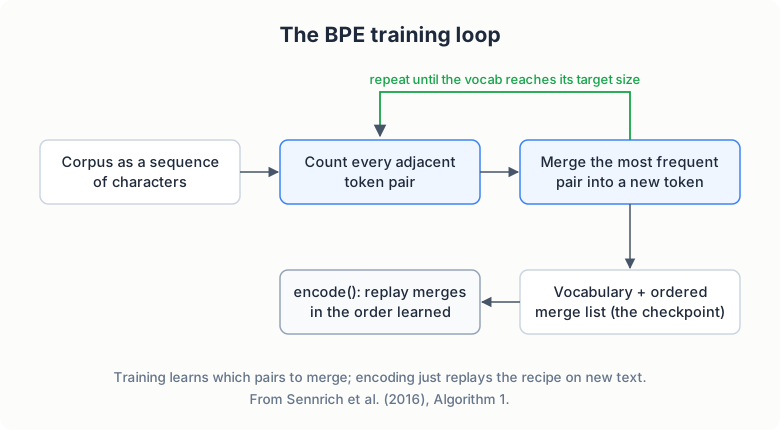
From Sennrich et al. (2016), Algorithm 1:
1. Initialize the vocabulary with all unique characters
2. Repeat until the target vocabulary size is reached:
   a. Count the frequency of every adjacent token pair
   b. Find the most frequent pair
   c. Merge it into a new token
   d. Apply the merge everywhere in the corpus
Worked example on "hug hug pug hug pug":
| Step | Operation | Vocabulary |
|---|---|---|
| Initial | characters | {h, u, g, p, ␣} |
| 1 | merge u+g → ug | {h, u, g, p, ␣, ug} |
| 2 | merge h+ug → hug | {h, u, g, p, ␣, ug, hug} |
| 3 | merge p+ug → pug | {h, u, g, p, ␣, ug, hug, pug} |
After training, encoding is greedy longest-match-first: apply the learned merges in the order they were learned.
Learned merges: [('e','r'), ('er','t'), ('ert','a')]
Text: "erter"
Step 1: ['e','r','t','e','r']
Step 2: ['er','t','e','r']      (apply 'e'+'r')
Step 3: ['ert','e','r']         (apply 'er'+'t')
Step 4: ['ert','er']            (apply 'e'+'r')
Scaling the training loop
The naive implementation recounts every adjacent pair across the entire corpus on every merge, which is O(corpus length) per merge. On an 11 MB WikiText corpus with a 5,000-token vocabulary that measured ~4.7 s/merge: a 5-hour run.
The fix in this repository is to represent the corpus as distinct words
with multiplicities (a Counter), so each merge iterates over ~50k unique
words instead of millions of characters, weighting pair counts by word
frequency. Merges still cross the word/space boundary because every word
carries a trailing space into training (so tokens like "the " are
learnable).
The result: about 5.8 merges per second, the same run in roughly 12 minutes, and an identical vocabulary. That’s a ~50× speedup for a representation change, not an algorithm change.
The code
As in Chapter 1, what follows is the repository’s code
(tokenizer.py)
with the commentary docstrings trimmed. Excerpts are condensed and lightly
reformatted; the logic matches the repository.
The training loop
class BPETokenizer:
    # PAPER: "Byte-Pair Encoding: Subword-Based Machine Translation",
    #        Sennrich et al. (2016), Algorithm 1

    def train(self, text, vocab_size, min_frequency):
        # 1. seed the vocabulary with every character in the corpus
        chars = sorted(list(set(text)))
        for char in chars:
            if char not in self.vocab:
                new_id = len(self.vocab)
                self.vocab[char] = new_id
                self.inverse_vocab[new_id] = char

        # 2. represent the corpus as distinct words with multiplicities
        normalized = " ".join(text.split())
        raw_words = normalized.split(" ")
        word_counts = Counter()
        for w in raw_words[:-1]:
            if w:
                word_counts[w + " "] += 1    # trailing space: word boundaries stay mergeable
        if raw_words and raw_words[-1]:
            word_counts[raw_words[-1]] += 1
        words = [list(w) for w in word_counts.keys()]

        # 3. the merge loop
        num_merges = vocab_size - len(config.SPECIAL_TOKENS) - len(chars)
        for merge_idx in range(num_merges):
            pair_counts = self._get_pair_counts(words, counts=list(word_counts.values()))
            if not pair_counts:
                break
            best_pair = max(pair_counts, key=pair_counts.get)
            if pair_counts[best_pair] < min_frequency:
                break

            new_token = best_pair[0] + best_pair[1]
            new_id = len(self.vocab)
            self.vocab[new_token] = new_id
            self.inverse_vocab[new_id] = new_token
            self.merges.append(best_pair)    # order matters: encode() replays it

            words = self._apply_merge(words, best_pair)
The trailing-space line deserves a pause. WikiText-2 is 11 MB of words
separated by whitespace, and BPE counts adjacent pairs; if words were
treated as isolated islands, the token the could never absorb the space
after it and real tokenizers’ the-with-trailing-space token would be
unlearnable. Appending the space to every word except the last keeps the
corpus equivalent to one long sequence, minus merges across newlines.
self.merges.append(best_pair) looks incidental and is not: encoding a
new string replays the merge list in exactly the order it was learned.
The same pair (a, b) merged early is a different operation than merged
late, because what a and b are depends on every merge before it.
Counting and applying a merge
    def _get_pair_counts(self, words, counts=None):
        # "Count the frequency of each adjacent pair" (Algorithm 1, step 2a)
        if counts is None:
            counts = [1] * len(words)
        pair_counts = Counter()
        for word, count in zip(words, counts):
            for i in range(len(word) - 1):
                pair = (word[i], word[i + 1])
                pair_counts[pair] += count
        return pair_counts

    def _apply_merge(self, words, pair):
        new_token = pair[0] + pair[1]
        new_words = []
        for word in words:
            new_word = []
            i = 0
            while i < len(word):
                if i < len(word) - 1 and word[i] == pair[0] and word[i + 1] == pair[1]:
                    new_word.append(new_token)
                    i += 2                   # both symbols consumed
                else:
                    new_word.append(word[i])
                    i += 1
            new_words.append(new_word)
        return new_words
_apply_merge scans left to right and consumes two positions on a hit
(i += 2), which is how overlapping runs resolve: ['l', 'l', 'l'] under
the merge ('l', 'l') becomes ['ll', 'l'], and the third l stays
single because the first two were consumed as one token.
The counts argument is the entire ~50x optimization from the previous
section. The naive implementation keeps one entry per corpus occurrence
and pays full-corpus cost per merge; passing word frequencies in means a
merge scans ~50k distinct words weighted by how often each occurs, and
the resulting pair counts are identical.
Encoding and decoding
    def encode(self, text):
        # greedy longest-match-first: replay merges in learned order (Algorithm 2)
        tokens = list(text)
        current = [tokens]
        for pair in self.merges:
            current = self._apply_merge(current, pair)
        final_tokens = current[0]

        token_ids = []
        for token in final_tokens:
            if token in self.vocab:
                token_ids.append(self.vocab[token])
            else:
                for char in token:   # fallback: spell the token out character by character
                    token_ids.append(self.vocab.get(char, config.SPECIAL_TOKENS["<UNK>"]))
        return token_ids

    def decode(self, token_ids):
        text_parts = []
        for token_id in token_ids:
            if token_id in self.inverse_vocab:
                token = self.inverse_vocab[token_id]
                if token in ["<PAD>", "<BOS>", "<EOS>"]:
                    continue
                elif token == "<UNK>":
                    text_parts.append("<UNK>")
                else:
                    text_parts.append(token)
        return "".join(text_parts)
Encoding needs no cleverness at all: start from characters, replay every
learned merge in order, look up the IDs. A merge only applies if both of
its symbols exist as adjacent tokens, so replaying in order automatically
produces longest-match-first behavior; the for loop is the algorithm.
Decoding is the reverse lookup, with the control tokens dropped from the
output text.
Data and configuration
# WikiText-2 (~10 MB, good for testing) or WikiText-103 (~500 MB)
uv run python phase1_foundation/project2_tokenizer/download_data.py --size small

# Train (5k vocab trains in minutes; GPT-2 uses 50,257)
uv run python phase1_foundation/project2_tokenizer/train_tokenizer.py --vocab_size 5000

# Round-trip tests + interactive exploration
uv run python phase1_foundation/project2_tokenizer/test_tokenizer.py --interactive
Special tokens
| Token | ID | Purpose |
|---|---|---|
<PAD> | 0 | Padding for batching |
<UNK> | 1 | Unknown fallback (rare; BPE covers all bytes) |
<BOS> | 2 | Beginning of sequence |
<EOS> | 3 | End of sequence |
These positional ids matter later: Chapter 3/4’s BERT-style models frame sequences by position (0 = pad, 2 = sentence start, 3 = separator).
What you should observe
- Very common words (
the,be) encode as a single token - Technical words split meaningfully:
hyper · parameter,transform · er - Compression of typical English text is ~2.5–3× versus characters
Code tour
| File | What to read |
|---|---|
tokenizer.py | BPETokenizer.train() (with the distinct-word optimization), _apply_merge, greedy encode() |
train_tokenizer.py | CLI, checkpoint format |
test_tokenizer.py | Round-trip and behavioral tests |
Exercises
- Train with
--vocab_size 1000vs5000and compare token counts for the same paragraph. Where does the extra vocabulary pay off? - Break the round-trip: find an input whose
decode(encode(x)) != x, and explain why. - (Hard) Implement incremental pair-count updates (only pairs adjacent to a merge site change) and benchmark against the distinct-word approach.
What’s next
Chapter 3 switches from generation to understanding: a bidirectional encoder pre-trained with masked language modeling, using this tokenizer.